Blog
December 8, 2023
Why Rocker Pipes and Flexible Joints are an Important Part of Sewer and Stormwater Design?



December 8, 2023
Rocker pipes are short sections of pipe designed to provide flexible joints that protect against localised ground movement. Design drawings issued for construction may specify the accepted length a rocker pipe should be for a given site or project; this is sometimes listed as a ratio of the diameter of the pipe.
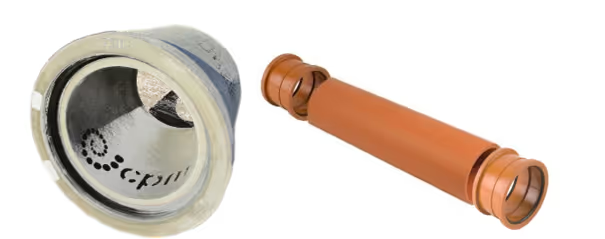
Rocker pipes are often a standard requirement where pipes enter or leave structures such as:
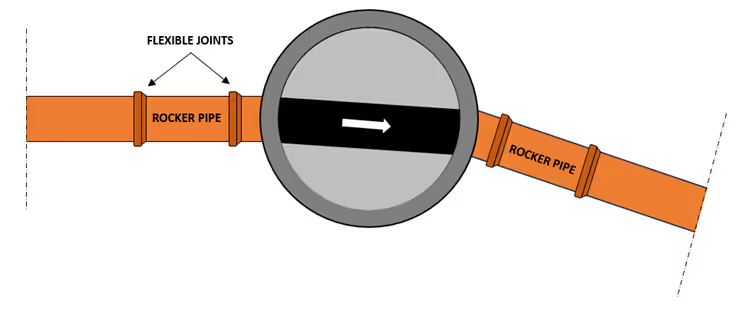
It is common for sewer designs to specify the requirement for two flexible joints approaching the inlet as well as downstream of the outlet of fixed structures. This may be satisfied with a dedicated rocker pipe, or a piece cut to suit with rubber ring joint couplings. Requirements can differ depending on the approving utility. An example specification where lengths depend on pipe diameter is listed below:
PIPE DIAMETER
MAX. LENGTH TO
FIRST FLEXIBLE JOINT
MAX. LENGTH BETWEEN FIRST & SECOND FLEXIBLE JOINT
DN150
(6”)
300mm
(12”)
600mm
(2ft)
DN225 – DN300
(9” – 12”)
350mm
(14”)
600mm
(2ft)
DN375 – DN450
(14” – 18”)
1.5 x DIA.
600mm
(2ft)
DN525 – DN1050
(20” – 42”)
1.5 x DIA.
1000mm
(3.3ft)
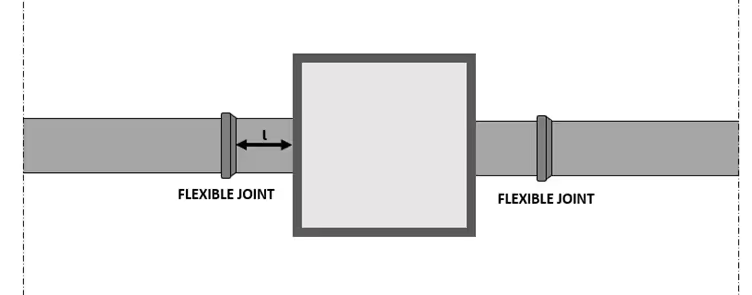
Stormwater specifications may list a rocker pipe, or in many cases state that the first flexible joint must be within a certain distance of the structure. An example is the NSW Transport Roads & Maritime Services’ standard drawing R0220-43 which specifies for pipes up to 450mm diameter the length (l) to the first flexible joint should be 600mm and for pipes over 450mm diameter this length is to be 1200mm.
A rocker pipe is specified in designs to address the effect that differential settlement can have on the first pipe that enters/leaves one of the structures listed above. Bedding and trench backfill undergo settlement during and soon after construction. The amount of settlement around the pipe may not be equal to that of the adjacent structure, this difference is known as differential settlement. It can be exacerbated by a range of factors including:
A rocker pipe, and the presence of flexible joints in the zone where differential settlement occurs provides the opportunity for the pipe to accommodate this load and movement. Without a flexible joint, the load will transfer to the pipe or structure and is often large enough to crack the pipe or cause damage at the pipe/structure interface.
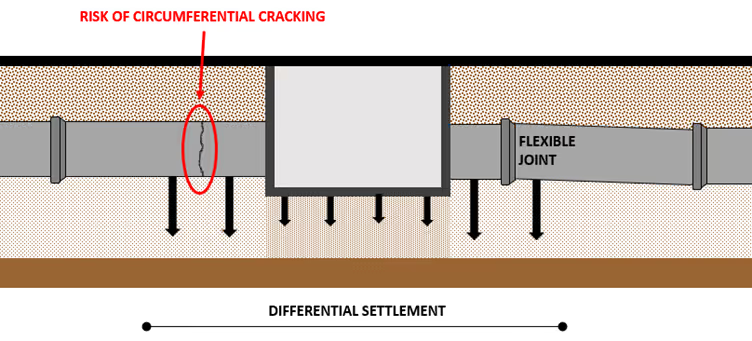
The image below of a newly constructed stormwater pipe without a flexible joint near the pit provides a clear example of where the external force from differential settlement has transferred to the concrete pipe and caused a significant circumferential crack.
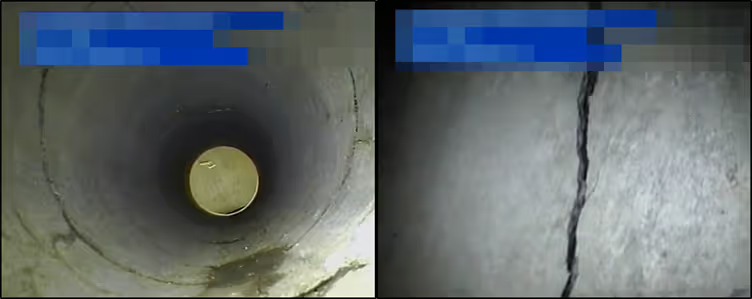
Defects resulting from the absence of flexible joints can be prevented through clear design specifications, monitoring construction, and a CCTV acceptance inspection workflow that is able to identify and rectify any issues prior to asset handover.
.jpg)