
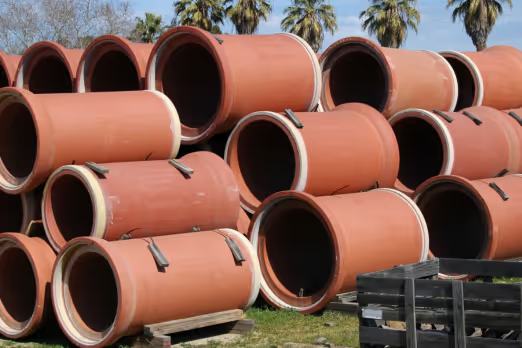
For centuries, clay sewer pipes have been a fundamental component of wastewater management. While newer materials such as PVC and HDPE have gained popularity, clay pipes continue to hold their ground due to their durability, sustainability, and long-term performance. In this blog, we explore the enduring relevance of clay sewer pipes and why they remain a strong contender in modern infrastructure projects.
A Time-Tested Solution with Modern Enhancements
Clay pipes have been used in sewer systems for thousands of years, dating back to ancient civilizations. Their longevity in infrastructure is not just due to tradition but also because of their proven effectiveness. Modern manufacturing techniques, including improved jointing systems and enhanced structural integrity, have further increased their reliability, making them a competitive choice in today’s projects.
In a notable project, Drainforce, a UK-based drainage solutions company, was tasked with addressing severe infiltration in a 225mm clay sewer pipe at Ffos Las Racecourse in Llanelli. The existing clay pipe, approximately 570 meters in length, had significant infiltration issues, leading to operational challenges. To remediate this, Drainforce implemented a UV lining technique, successfully installing a 300-meter liner in a single length—the longest of its kind in the UK. This approach not only restored the structural integrity of the aging clay pipe but also extended its service life, demonstrating how modern rehabilitation methods can enhance the performance of traditional clay sewer systems.

A Natural and Sustainable Choice
Sustainability is a key concern in contemporary infrastructure development, and clay pipes offer an eco-friendly alternative to synthetic materials. Made from natural, abundant raw materials, clay pipes have minimal environmental impact and can be recycled at the end of their lifecycle. Their production process also consumes less energy compared to plastic-based alternatives, reducing their overall carbon footprint.
Exceptional Resistance to Corrosion and Chemicals
One of the major challenges in sewer systems is exposure to aggressive chemicals and biological elements. Clay pipes have a natural resistance to corrosion, unlike metal pipes that may rust over time. They are also unaffected by acids, alkalis, and sewer gases, making them ideal for wastewater applications where chemical exposure is a significant concern.
Structural Strength and Longevity
Clay pipes are known for their ability to withstand heavy loads and soil pressure, making them suitable for deep-buried installations in urban environments. Unlike flexible materials that may deform over time, clay pipes maintain their rigidity and structural integrity for decades. Many historical sewer systems made of clay are still in operation today, proving their long-lasting reliability.
Cost-Effectiveness in the Long Run
Although the upfront cost of clay pipes may be higher than some alternatives, their long-term benefits make them a cost-effective solution. Their extended lifespan, low maintenance requirements, and resistance to damage mean fewer replacements and repairs over time, translating into significant savings for municipalities and utility providers.
A case study from Casa Grande, Arizona, highlights the long-term cost-effectiveness of vitrified clay pipes (VCP) in sewer infrastructure. In this project, a 24-inch diameter VCP was installed over a length of 4,583 feet for the Gila Bend Sewer Interceptor. The initial installation cost for the clay pipe was approximately $273,000. In comparison, installing PVC pipes for the same project was estimated at $276,000. While the upfront costs were comparable, the expected service life of the clay pipe is 100 years, whereas PVC pipes have an anticipated lifespan of 50 years. Accounting for the need to replace PVC pipes after 50 years, the net present cost for achieving a 100-year service life with PVC rises to $361,000. This results in a cost per foot per year of $0.59 for clay pipes, compared to $0.79 for PVC pipes, demonstrating that despite similar initial costs, clay pipes offer a more economical solution over the long term due to their durability and longevity.
Conclusion
Clay sewer pipes continue to be a relevant and valuable choice for modern infrastructure. Their durability, sustainability, chemical resistance, and structural integrity make them a preferred option for wastewater management systems. With advancements in technology and growing emphasis on environmentally friendly solutions, clay pipes are likely to remain a key component of sewer systems for years to come.
Moreover, as cities expand and demand greater efficiency from their wastewater infrastructure, the need for materials that can endure harsh conditions while minimizing long-term maintenance costs will only increase. Clay pipes, with their natural resistance to degradation and ability to function reliably for over a century, align perfectly with these requirements.
Furthermore, governments and municipalities are increasingly adopting sustainable construction practices, making clay pipes an even more attractive option. Their eco-friendly manufacturing process and recyclability support global initiatives toward reducing environmental impact and promoting circular economies.
Incorporating clay pipes into modern infrastructure planning ensures a future-proof investment, combining historical reliability with cutting-edge advancements. As the industry continues to evolve, clay pipes will remain a cornerstone of effective, sustainable, and resilient wastewater management.
Articles
.jpg)