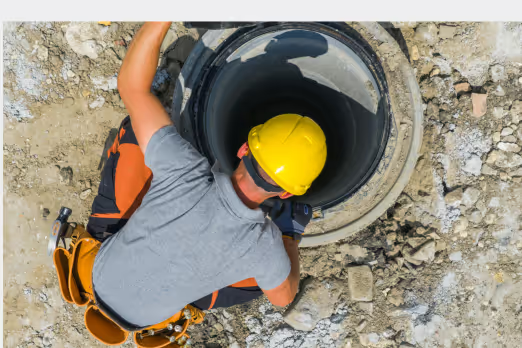

As urban areas expand and drainage infrastructure ages, maintaining drainage systems is becoming increasingly vital to prevent flooding, protect the environment, and ensure public safety. Traditional methods for inspecting and repairing drainage pipes are often expensive, labor-intensive, and time-consuming, requiring extensive excavation and causing significant disruption. However, advancements in technology are transforming how we approach drainage system maintenance, making it faster, more efficient, and less invasive. In this blog, we will explore some of the cutting-edge technologies that are revolutionizing the field of drainage pipe maintenance.
Internal Inspection Technologies: Enhancing Precision and Reducing Downtime
Inspecting drainage pipes is a critical first step in identifying issues like blockages, leaks, or cracks. Traditional inspections often require excavation or manual entry into drainage systems, which can be risky and disruptive. However, internal inspection technologies are now providing engineers with non-invasive, accurate tools to assess pipe conditions remotely.
- CCTV Cameras: Remote-controlled CCTV cameras are now widely used to inspect drainage pipes. These small, flexible devices can be navigated through pipes, providing clear visuals of blockages, cracks, and other defects without the need for manual intervention. They offer detailed footage that can be reviewed in real-time or stored for future analysis.
- Drones: In large or hard-to-access drainage systems, drones equipped with sensors are increasingly being used for inspections. Drones can cover extensive areas quickly, making them ideal for surveying above-ground drainage infrastructure or large, remote areas.
By using these and other inspection technologies, maintenance teams can detect problems early, reducing repair costs and minimizing downtime for communities.
AI and Predictive Maintenance: Data-Driven Solutions for Pipe Condition Assessment
Artificial Intelligence (AI) and machine learning are playing a crucial role in revolutionizing the condition assessment and maintenance of drainage pipes. By analyzing large volumes of data collected from CCTV footage, sensors, and other sources, AI can detect issues more efficiently and accurately than traditional methods.
- Automated Defect Detection: AI algorithms can analyze visual data from inspections to detect defects such as cracks, leaks, or pipe deformations. These systems are often more precise than human inspectors, improving the accuracy of the assessments.
- Predictive Maintenance: By leveraging historical data, AI can predict where potential issues might occur in the future. Predictive maintenance helps drainage system managers schedule repairs proactively, preventing emergencies and reducing costly reactive repairs. This approach also extends the life of infrastructure by addressing problems before they become severe.
AI and predictive maintenance not only streamline the inspection process but also ensure timely interventions, significantly improving the efficiency of drainage system maintenance.
Trenchless Technologies: Minimizing Disruption in Pipe Repairs
Traditional pipe repair methods often require digging up roads, sidewalks, or landscapes, causing disruptions and increasing costs. Trenchless solutions offer an alternative that minimizes these drawbacks.
- Pipe Relining: In pipe relining, a flexible tube coated with resin is inserted into the damaged pipe. Once inflated and hardened, this resin forms a new pipe within the old one, restoring the integrity of the drainage system. This method is quick, cost-effective, and minimizes disruption.
- Pipe Bursting: Pipe bursting involves breaking apart the old, damaged pipe and simultaneously pulling a new pipe into place. This method is ideal for cases where the old pipe is too damaged to be relined or needs to be replaced entirely.
Trenchless technologies reduce the need for large-scale digging, lower costs, and result in shorter project timelines, making them highly efficient for maintaining aging infrastructure.
Conclusion
The advancements in drainage pipe maintenance are transforming the way cities manage their essential infrastructure. From smart inspections and AI-driven assessments to trenchless repairs, these technologies are not only making the process more efficient but also reducing costs, minimizing environmental impact, and extending the lifespan of drainage systems. As urban populations grow and infrastructure ages, these innovations will continue to play a pivotal role in ensuring that our drainage systems are maintained effectively and sustainably for the future.
Articles
.jpg)